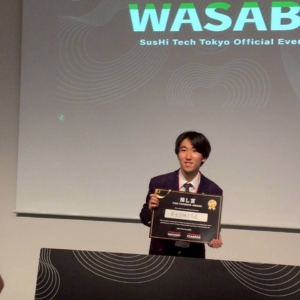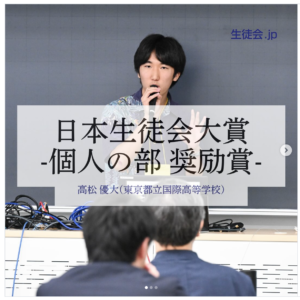



Yuta Takamatsu
Tokyo Metropolitan Kokusai High School, International Baccalaureate Course
At AMICUS, our educational philosophy is to nurture “independent children who can think, learn, and act for themselves, and open their own path for the future.” We carry out our daily educational activities based on this philosophy. Another important feature of AMICUS is its diverse learning environment.
AMICUS is now in its 16th year. Some of our graduates are now old enough to enter university and are beginning new learning and challenges in different places. Therefore, we conducted email interviews with some of our graduates. Our first interview is with Mr. Yuta Takamatsu. Please enjoy reading it.
Q1. What kind of skills or strengths did you develop at AMICUS?
For me, my experience at AMICUS is the foundation of who I am today. It is difficult to describe in one word, but I feel that I developed important strengths that cannot be measured by numbers. These may be called “human strengths” or “personal qualities.”
If I had to put it into words, I would say it is “the ability to accept diversity as something natural and enjoy it.” At AMICUS, diversity existed naturally. It was not only diversity in nationality or cultural background, but also diversity in ways of thinking, interests, and values. Through this environment, I learned to see “differences” not as something special or unusual, but as new perspectives and new possibilities.
I also feel that the rich natural environment, the warm atmosphere where teachers were close to students, and the variety of school events created a sense of space and flexibility throughout the school. This kind of environment became a foundation not only for building basic academic skills, but also for developing each student’s interests and possibilities.
Q2. After graduating from AMICUS, how have your experiences at AMICUS helped you?
My experience at AMICUS is also the starting point of my desire to be involved in education in the future. At first, I thought of education from the position of someone who receives it. However, through meeting many different people and being in diverse environments, I began to think that I would like to be on the side of providing education. I want to help create systems that bring out the potential of each person.
In doing so, I value the ability to connect different elements, such as the global and the local, and technology and culture. I also believe it is important to keep asking questions, rather than simply trying to find answers.
In a practical sense, I developed basic academic skills at AMICUS, such as giving presentations, writing essays, and citing sources. These skills helped me after I entered the International Baccalaureate course in high school, especially when I had to write academic papers.
In terms of relationships with others, the sense I developed at AMICUS is also very useful in my current activities. In student council activities and outside projects, I try to value face-to-face communication while also making good use of online communication and combining both approaches. In addition, in this age of rapidly developing AI, my AMICUS experience has helped me pay attention to values that only humans can create, as well as cultural resources that have not yet been digitalized.
Q3. Please tell us about your current activities and your dream for the future.
Currently, I am working as the representative of EToE, a student organization that I founded. Based on my experiences in Okinawa, our vision is to realize “education where everyone can fully explore their own potential.”
One of our main activities is using information technology in education. For example, we are developing our own educational program called “Metalorea,” which uses a metaverse space. We also plan hybrid events that combine online and offline activities. However, we do not simply believe in technology by itself. We place importance on connecting technology with local culture and face-to-face discussion. Through this, we aim to realize diverse forms of education from the bottom up.
In Okinawa, which is my starting point, I am also studying history and culture, including the Ryukyu Disposition. In addition, through educational support activities, hands-on events, and community management, I continue to explore new forms of learning.
In the future, I would like to contribute to building a society and an education system where everyone can develop their potential to the fullest. After studying education at university, I hope to continue my research in educational informatics at graduate school. My goal is to become a person who can return professional knowledge to society, especially in the field of applying information technology to education.
What I Felt After the Interview
I am very happy to know that Mr. Takamatsu deeply understood what AMICUS values, and that he is making use of those experiences in his learning and activities after graduation. In particular, the phrase “the ability to accept diversity as something natural and enjoy it” stayed in my mind.
Japanese society will become more and more diverse in the future. In a sense, AMICUS may be a school that is already experiencing the kind of society we will see in the future.
Diversity enriches society. At the same time, the more diverse a community becomes, the more difficult it can sometimes be for people to understand each other and live together. That is why I believe “the ability to accept diversity as something natural and enjoy it” will be a very important strength in the society of the future.
I was also impressed by the words, “while valuing face-to-face communication.” We now live in an age where many things can be done online. However, the experience of meeting people directly, feeling their thoughts, showing consideration, and respecting one another is essential for human growth. In this sense, it is very meaningful for children to gather at AMICUS and learn together with their friends and teachers.
I was also happy to know that even after leaving Okinawa, Mr. Takamatsu continues to study Okinawan history and culture. I felt that he values both the global and the local.
Through Mr. Takamatsu’s words, I was once again able to feel the value of AMICUS education. Thank you very much.
Interviewer: Ken Oshiro, Headmaster, AMICUS