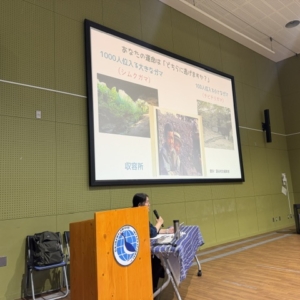



At the AMICUS Junior High School Peace Assembly, we welcomed Ms. Tamaki from Una Okinawa. She spoke to us about the Battle of Okinawa and the refugee problems that continue in many parts of the world today. During her talk, she introduced the stories of Chibichiri-gama and Shimuku-gama, two caves in Yomitan Village.
The two caves are only about 800 meters apart. However, what happened in them was very different. At Chibichiri-gama, 82 residents were driven to take their own lives. At Shimuku-gama, on the other hand, more than 1,000 people survived without losing a single life.
At that time, bullets were flying outside the cave. It was so dangerous that going outside seemed almost certain to lead to death. Even inside Shimuku-gama, some people believed that it would be better to die than to be captured by American soldiers. Others wanted to take bamboo spears and fight the enemy.
In this extreme situation, two person who had returned from Hawaii, Heiji Higa and Heizo Higa, helped calm the people. Heiji said, “I will go and talk to the American soldiers.” He then left Shimuku-gama while bullets were flying outside.
After speaking with the American soldiers, they returned to the cave and told the people, “The American soldiers said that they would not kill civilians. Let us leave the cave.” The people trusted their words and came out. They survived, and their children and grandchildren continue to live today.
As I listened to Ms. Tamaki, I remembered a book I had read many years ago, The “Group Suicide” at Chibichiri-gama, Okinawa by Tetsuro Shimojima. I also remembered entering Shimuku-gama myself with a flashlight.
Around 1990, I was working as a junior high school English teacher. I worked hard to teach grammar, such as the third-person singular and conditional sentences. At the same time, however, I often asked myself, “Why am I teaching English? What should the real purpose of English education be?”
It was around that time that I found Mr. Shimojima’s book. From Heiji and Hizo Higa’s actions, I learned three important goals of English education.
The first is to believe in the power of language and to develop the ability to use English to communicate honestly and sincerely.
The second is to understand other people’s cultures and ways of thinking. Without this understanding, it is difficult to communicate well in English.
The third is not limited to English education. It is to use what we have learned and take action with courage.
Mr. Heizo and Heiji Higa could speak English. However, English ability alone would not have enabled them to leave the dangerous cave. I believe they were able to act because they strongly trusted the power of words. They believed that communication could open a path to safety.
They also understood that American soldiers were human beings and that they would not kill civilians without reason. Their understanding of American culture and way of thinking led them to take action that saved many lives.
At the Peace Assembly, I saw for the first time a photograph of Mr. Heiji and Hizo Higa speaking with American soldiers. Both Mr. Heizou and Heiji Higa and the soldiers were sitting on the ground and appeared to be looking into each other’s eyes as they talked. It was not simply a brief conversation between people standing in the street. It was a serious meeting between human beings who were trying to protect people’s lives.
Later, I met Professor Eiji Saito, who was teaching at Kyoto University of Education at the time. From him, I learned a great deal about what English teachers should aim for. His ideas were closely connected to the three things I had learned from Mr. Heiji and Heizo Higa’s actions: trust in the power of language, understanding other cultures, and having the courage to act.
At the end of the Peace Assembly, I was asked to give a message. I made the following request to the AMICUS junior high school students:
“Please believe in the power of words. Believe that we can understand one another through communication. Please also deepen your understanding of other cultures. There are many different cultures and values in the world. Learning about others can lead us toward solutions. And when necessary, please have the courage to take action.”
As Heiji and Heizo Higa showed us, words have the power to move people, save lives, and create the future.
I hope that Irei-no-Hi will not be only a day to remember the sad events of the past. I hope it will also be a day for us to think about how we should live from now on.
Ken Oshiro, Headmaster