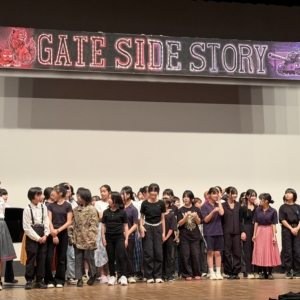



Last Saturday, we held AMICUS Junior High School Performance Day. Because of the typhoon, we had to change the starting time from the morning to the afternoon. Despite this sudden change, many parents and guardians came to see the performance. I would like to express my sincere gratitude to all of you.
I personally had very special feelings about this year’s musical, Gate Side Story.
When I was a university student, I studied Shakespeare’s Romeo and Juliet in an English literature class. It is a sad story about two young people born into families that are enemies. They fall in love despite the opposition around them, but in the end, both of them lose their lives.
This story was later passed on to West Side Story, set in New York in the 1950s. Against the background of conflict between two groups of young immigrants, a young man and woman from opposing sides meet and fall in love. However, this story also ends in tragedy, with one of them losing his life.
In our AMICUS production of Gate Side Story, the setting moves to Koza in the 1970s. Against the background of the complex relationship between the U.S. military bases and the people of Okinawa, Tony, an American soldier, meets Mari, an Okinawan woman, and they fall in love.
What kind of ending would they face? From the time I first read the script, I followed their story with great interest. Many times, I thought, “Perhaps this time, the story could have a happy ending.” However, once again, the two lovers are separated by fate. The story ends without revealing what happened to Tony, while Mari continues to wait for his return. This was also a scene often seen in Okinawa at that time.
When we look around the world today, wars and conflicts are still continuing. Perhaps the teachers and students who wrote the script felt that, in such a world, it would not be right to create a simple happy ending.
I also felt that the ending raised a question for adults who have created a society in which even pure love is not allowed to grow. Why must people be divided and hate one another because of differences in nationality or social position? To me, this performance seemed to ask that quiet but important question of all of us adults.
Through this project, I believe our students learned many important lessons. They learned not only about Okinawa’s history, but also about working together with others, taking responsibility for their own roles, and trying to understand people with different ideas and points of view.
Of course, the students who performed on stage worked very hard. However, the students who supported the production through music, sets, props, costumes, lighting, sound, and many other roles also gave their very best. Each person’s contribution may have seemed small on its own, but when all those efforts came together, they created a powerful performance that touched the hearts of the audience.
I would also like to express my heartfelt gratitude to the teachers who guided, encouraged, and supported the students over a long period of time. Behind the scenes were the teachers’ extraordinary effort and passion, including their response to the sudden schedule change caused by the typhoon. This performance could not have been possible without the teachers who believed in the students and stayed beside them until the very end.
We also received tremendous support from our parents and guardians through crowdfunding. In addition, you watched over the students’ daily rehearsals, encouraged them, and strongly supported their activities behind the scenes. Thank you very much.
Gate Side Story is scheduled to be performed again in three years. By that time, I hope the world will have become a little more peaceful, and that the next Mari and Tony will finally be able to reach a happy ending.
I would like to cherish that hope together with our students, teachers, parents, and guardians.
Ken Oshiro, Headmaster