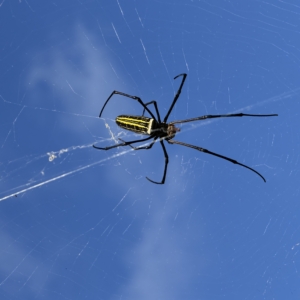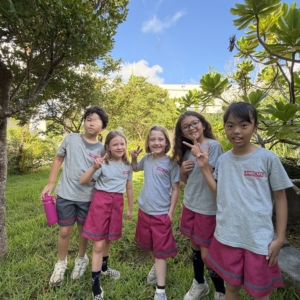



Yesterday, while I was walking around the school building, several international students came up to me excitedly.
“Principal, there is a spider! And it has babies!”
The children almost pulled me by the hand as they led me to the courtyard. When I looked where they were pointing and saying, “Look!”, I saw a large spider. Around it, about eight tiny baby spiders were moving.
Other children heard our excited voices and came over. At first, the international students had been speaking in English. Then one of them called out to a friend in Japanese,
“Hey, look! There is a big spider!”
For a while, English and Japanese naturally flowed back and forth among the children.
The children did not seem to be thinking about whether they were using English or Japanese. They were simply excited about finding the large spider and watching the baby spiders move. They could not wait to share what they had discovered with others.
“I wonder if this butterfly will get caught in the spider’s web…”
Their curiosity continued to grow.
The purpose of language learning is not only to learn vocabulary and grammar. We learn language so that we can tell others about things that surprise us, things we wonder about, and things that make us happy. When children have something they truly want to communicate, they become eager to learn words, choose the language that best fits the situation, and share their feelings with their friends.
I believe this is one of the special features of immersion education at AMICUS.
At AMICUS, children develop both English and Japanese while sharing many experiences with their friends and teachers in our green and natural environment. The results of this kind of learning are not always immediately visible. Sometimes, language development takes time. However, the language children gain through these experiences is not English only for tests. It becomes real, useful English that helps them connect with others and express their own thoughts and feelings.
As I watched the children gather around the spider and its babies, talking with bright eyes in English—and in Japanese when needed—I once again felt the richness of education at AMICUS.
Ken Oshiro, Headmaster