


At a recent junior high school morning assembly, I spoke to our students about the importance of thinking for themselves.
I began by introducing an experiment called the “Wug Test,” conducted by an American psycholinguist nearly 70 years ago.
In this experiment, the researcher showed children a picture of a strange-looking creature and said, “This is a wug.” The children were then shown another picture with two of these creatures and asked, “Now there are two of them. What would you call them in English?” Surprisingly, many of the children answered, “Two wugs,” even though no one had ever taught them that word.
In fact, wug is a made-up word invented by the researcher. The children had never learned the word wugs. Instead, they drew on what they already knew about English, recognized a pattern, and applied it to a completely new word.
This experiment reveals something remarkable about the human mind. Even when we encounter something unfamiliar, we have the ability to draw on our knowledge and experience, make predictions, use our imagination, and come up with new answers.
And this ability is not limited to learning English. The same is true when we tackle a difficult math problem, get unexpected results in a science experiment, or face challenges in our relationships with friends. By asking ourselves questions such as “Why did this happen?” “What would happen if I tried this?” or “Is there another way?”, we learn and grow through the process of trial and error.
Today, with the rapid development of generative AI, we live in a world where answers to many of our questions are just a few clicks away. AI is an incredibly useful tool, and I use it quite often myself. However, precisely because it is so convenient, there is something I want our students to think about.
What happens to our ability to think for ourselves if we immediately turn to AI for answers whenever we encounter something we don’t understand?
Of course, there is nothing wrong with using AI. What matters is how we use it. When faced with a difficult question, I want students to first think about it themselves, make predictions, and try different approaches. If they still cannot find an answer, they can turn to AI for hints or guidance—and then return to thinking for themselves.
This is the kind of learning I hope to encourage.
During the assembly, I also reminded the students that there is absolutely nothing wrong with making mistakes. In fact, some of our most valuable learning takes place when we make mistakes, try again, and work through challenges.
In an age when AI can provide answers so easily, I believe it is more important than ever to help children develop the ability to ask their own questions, think critically, make decisions, and take action.
With these thoughts still on my mind, I received some wonderful news this morning.
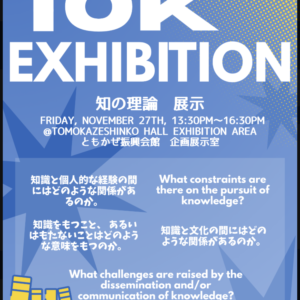
One of our graduates, who is now studying in the International Baccalaureate (IB) Programme at Okinawa Shogaku High School, sent us an invitation to a TOK Exhibition, saying, “We’re holding a TOK Exhibition, and we’d love for you to come and see it!”
TOK stands for Theory of Knowledge, one of the distinctive components of the International Baccalaureate Diploma Programme. It encourages students to explore fundamental questions such as “How do we know what we know?” and “How certain can we be about our knowledge?” Through these questions, students examine how knowledge is acquired, what counts as evidence, and how we justify what we believe to be true.
The TOK Exhibition gives students an opportunity to explore these questions by connecting them to objects from the real world and presenting their own ideas and interpretations.
I see a strong connection between the philosophy behind TOK and the educational values we cherish at AMICUS: “Think, Learn, Act.”
Learning is not simply about memorizing facts or acquiring information. It is about being curious, asking meaningful questions, examining issues from different perspectives, and developing our own understanding.
This is exactly the kind of approach to learning that we have been working to nurture at AMICUS.
I am delighted to see one of our graduates continuing to develop and express their own ideas in a new learning environment. I sincerely hope that the skills and attitudes they developed at AMICUS will serve them well as they take on these new intellectual challenges.
The exhibition is scheduled for Friday afternoon. I am not yet sure whether my school commitments will allow me to attend, but I would very much like to visit if possible and see firsthand how our graduate is learning and growing.
Learning at AMICUS does not end when students graduate. My hope is that the ability to think independently, learn actively, and take meaningful action will continue to guide them throughout their education and in the many experiences and challenges they encounter later in life.
As a school, I hope we will continue to create an environment where children do not simply look for quick answers, but instead learn to think for themselves, embrace uncertainty, make mistakes, and persevere as they search for solutions.
Ken Oshiro, Headmaster